


How to Spot Misleading Supplement Labels Before You Buy
Last Updated: November 24, 2026
Quick Summary
To spot misleading supplement labels, start with the Supplement Facts panel and check the serving size, since every amount is per serving. Look for specific doses for each ingredient, and be wary of proprietary blends that hide individual amounts. Treat front-label claims as marketing, and confirm any certification seal in the certifier's public database.
- Every amount on the Supplement Facts panel applies per serving, not per bottle.
- Multiply serving size by servings per container to find how many capsules the bottle holds.
- A proprietary blend with one total weight and no individual amounts hides the dose of each ingredient.
- A disease-treatment claim like "cures arthritis" is a serious red flag on any supplement label.
- Confirm any certification seal by searching the certifier's public product list for the exact product and lot.
Table of Contents
- How to Read Supplement Labels: The Supplement Facts Panel
- Proprietary Blends and Hidden Ingredient Amounts
- Checking Third-Party Tested Supplements and Certification Claims
- How to Spot a Fake Supplement: Label and Listing Discrepancies
- Serving-Size Math and Evidence Behind Health Claims
- Your Next Step: Running a Label Audit Before Your Next Purchase
- Frequently Asked Questions
How to Read Supplement Labels: The Supplement Facts Panel
Supplement labels look official, but they are easy to misread. A supplement label is the main way you learn what is in the bottle, so reading it carefully is one of the best defenses against misleading products.
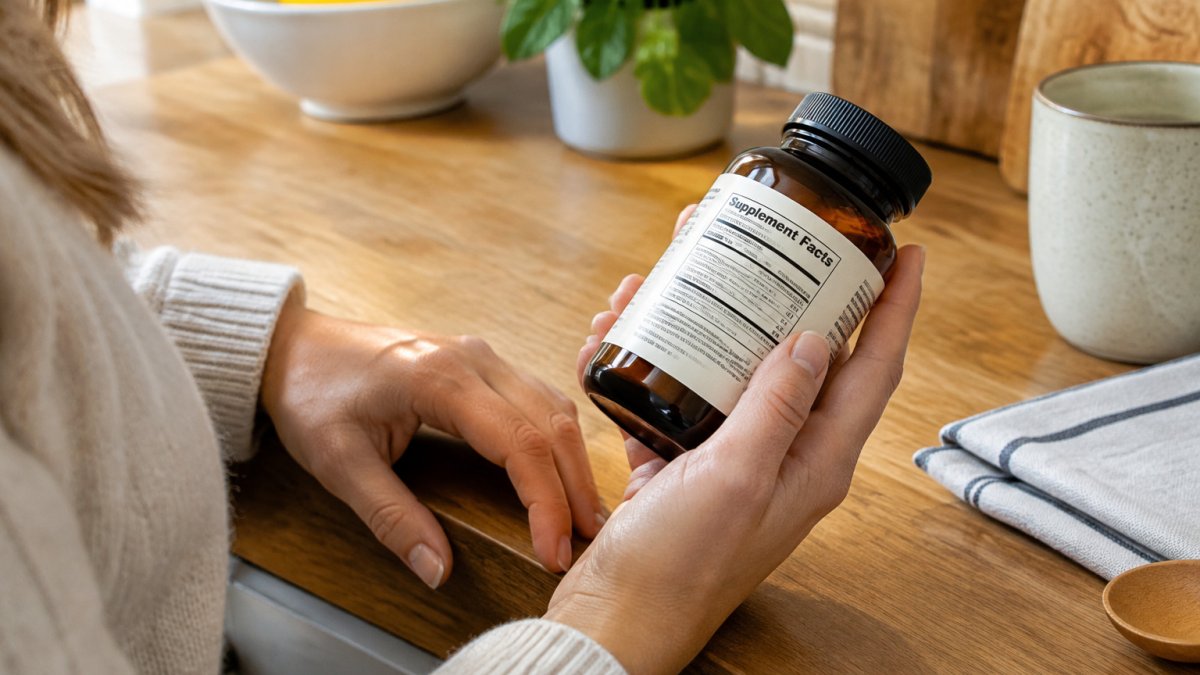
Start with the box itself. The panel should be a clearly labeled section, usually on the back or side of the bottle.
Proprietary Blends and Hidden Ingredient Amounts
A proprietary blend is a group of ingredients listed under one total weight, with no amount for each item. For example, a label might show "Energy Blend: 800 mg" and list five herbs beneath it, without saying how much of each one is inside.
This is the main way a product can look impressive while hiding weak doses. If one herb makes up 790 mg of that 800 mg blend and the others are tiny, you have no way to know. Here is what to look for:
- A single total weight for several ingredients
- Ingredients listed in order of weight, but no amounts
- A "proprietary" or "patented" label without any dose details
If you can't tell what dose you are getting, you can't judge whether it's worth buying. Skip the product or contact the company and ask for the exact amounts.
Checking Third-Party Tested Supplements and Certification Claims
Some products carry seals from independent testing groups.
Not all seals are equal. Some verify that the product contains what the label says in the amounts listed.
Here are the verification programs you are most likely to see on a supplement label, and what each one covers:
- USP Verified Mark. The United States Pharmacopeia runs a verification program that checks certain aspects of product quality. Check USP's published materials for the current scope of its program.
- NSF Certified for Sport. NSF International's sports program tests for substances banned by major athletic organizations, in addition to confirming label accuracy and contaminant limits.
- NSF Contents Certified. A broader NSF program that verifies label claims and screens for contaminants but does not carry the sport-specific banned-substance testing.
To verify any seal, follow these steps:
- Find the certifier's name printed on the label, not just the seal image.
- Visit the certifier's website and search its public product list.
- Confirm the exact product name, brand, and lot number match.
- Check the date. Certifications can expire or change.
Watch out: a seal that does not appear in the certifier's public database is a warning sign.
Be skeptical of vague quality language that is not tied to a named certifier. For a step-by-step method to confirm what a label really discloses, see verify ingredient transparency. To understand what independent lab testing actually proves, read independent lab testing explained.
Also check what the seal does not cover. A purity seal does not prove the product works.
How to Spot a Fake Supplement: Label and Listing Discrepancies
Problems often show up when you compare the bottle with the online listing. The product photo, the ingredient list, and the claims should all match. If they don't, something is off.
Compare these details side by side:
- The ingredient list on the website versus the bottle
- The serving size and count shown online versus printed
- Claims that appear only in ads, not on the label
- Seals or certifications shown in photos but missing from the bottle
Be careful with listings that use stock photos, copy text from other brands, or have no contact information. Report the listing to the marketplace and, if the problem involves serious harm, to the FDA MedWatch reporting program.
Serving-Size Math and Evidence Behind Health Claims
Before you trust a health claim, do the math.
Here is how to run the math on any product:
- Find the serving size. It is the first line under the Supplement Facts heading, for example "Serving Size: 2 capsules."
- Find servings per container. This tells you how many servings the bottle holds, for example "30 servings."
- Calculate total capsules. Multiply serving size by servings per container: 2 capsules × 30 servings = 60 capsules in the bottle.
- Calculate days of supply. Divide total capsules by the number of capsules you would actually take per day. If the label directs two capsules daily, 60 capsules ÷ 2 = 30 days.
- Calculate cost per day. Divide the purchase price by the days of supply. A $30 bottle that lasts 15 days costs $2 per day; a $45 bottle that lasts 45 days costs $1 per day. The cheaper-looking bottle is often the more expensive one per day.
- Compare equivalent doses. To compare two products fairly, convert both to the same unit and the same serving basis. If Product A lists 500 mg per capsule and directs two capsules daily, the daily dose is 1,000 mg. If Product B lists 1,000 mg per two-capsule serving and directs one serving daily, the daily dose is also 1,000 mg. Now compare price per day, not price per bottle.
Watch out: front-label quantities are often per serving, not per capsule, and the serving may be several capsules.
Proprietary blends make this math harder.
Once you know the real daily dose, compare it with the dose used in the research behind the claim. For help reading clinical studies behind supplement marketing, see interpreting clinical supplement research. The National Institutes of Health Office of Dietary Supplements publishes fact sheets that summarize the evidence for many ingredients.
Ask yourself three quick questions:
- Is the dose on the label close to the dose in the research?
- Was the research done in people, and was it independent?
- Does the claim match what the research actually measured?
If the answer to any of these is no, the health claim is doing more work than the evidence supports.
The article walks through the serving-size math step by step, so this table summarises those steps for quick reference.
| Step | What to do | Note |
|---|---|---|
| 1. Find serving size | Read the first line under Supplement Facts | Example: 2 capsules |
| 2. Find servings per container | Check the count on the panel | Example: 30 servings |
| 3. Calculate total capsules | Serving size × servings per container | Example: 2 × 30 = 60 |
| 4. Calculate days of supply | Total capsules ÷ capsules taken per day | Example: 60 ÷ 2 = 30 days |
| 5. Calculate cost per day | Purchase price ÷ days of supply | Compare per-day cost, not bottle price |
| 6. Compare equivalent doses | Convert both products to the same daily dose | Compare price per day |
Your Next Step: Running a Label Audit Before Your Next Purchase
Before you buy again, run a quick audit. Pick up the bottle, find the Supplement Facts panel, and work through it in order: serving size, ingredient amounts, proprietary blends, claims, and disclaimer.
Doing this once takes about five minutes, and it will catch most misleading labels. Browse our full range at anchor words or look at the options on our shop page to see how a transparent label should look.
Frequently Asked Questions
How can you tell whether a supplement claim is supported by evidence?
Start by checking whether the claim names a specific, measurable outcome or only uses vague language such as 'supports immunity' or 'boosts energy.' Look for cited studies that tested the same ingredient at the same dose, in humans rather than only in cells or animals, and published in peer-reviewed journals. A single small study or a manufacturer-funded report is weak support. The FDA does not approve dietary supplements for effectiveness before they are sold, so the burden of evidence falls on you to check. If a brand cites research but cannot name the study or link to it, treat the claim as unverified.
What is the difference between a structure/function claim and a health claim?
A structure/function claim describes how an ingredient may affect the body's normal structure or function, such as 'supports joint comfort' or 'helps maintain healthy skin.' Manufacturers can make these claims without FDA approval, but they must include the FDA disclaimer. A health claim links a nutrient or supplement to reducing the risk of a specific disease, and it generally requires FDA authorization. Claims that say a product treats, cures or prevents a disease are disease-treatment claims, and they are not permitted on supplement labels. Seeing one is a strong red flag.
Does a third-party certification mean a supplement is effective?
No. A third-party seal from a recognized testing organization generally confirms that the product's label is accurate: the listed ingredients are present in the stated amounts and the product meets purity and contamination standards. It does not confirm that the product works for any health purpose. Check which organization issued the seal, search its public database to confirm the product is listed, and verify that the product in your hand matches the certified formulation and lot. Certification addresses quality, not clinical benefit.
What should you do if a supplement label seems misleading?
Document what you see by photographing the label, the Supplement Facts panel and any claims. Compare the claims against the label and the brand's website. If the claims promise disease treatment or guaranteed results, or if the ingredient amounts are hidden inside a proprietary blend, consider contacting the manufacturer in writing and asking for the exact per-serving amounts and supporting studies. You can report unsafe or fraudulent products to the FDA through its MedWatch program and to the Federal Trade Commission for deceptive advertising. Stop using the product if you have side effects, and talk to a healthcare professional before continuing.


